How Financial Analysis Can Benefit Your Small Business
How Financial Analysis Can Benefit Your Small Business
For small businesses, financial analysis acts as a roadmap. It is a robust tool for making better-informed decisions and avoiding danger. Financial analysis is the process of analyzing a company’s financial accounts and computing ratios in order to assess its stability and profitability—this aids in identifying areas of strength and weakness. Stakeholders must understand where a firm stands regarding profitability, liquidity, and solvency.
Financial analysis necessitates a blend of analytical, problem-solving, and technological abilities. Accountants can help businesses in both the immediate and long term by offering extensive financial statement analysis. According to Accounting Tools, financial statement analysis evaluates an organization’s financial statements to acquire knowledge of its financial status.
A balance sheet, income statement, statement of cash flows, and additional notes are standard components of financial statements. Employees, executives, government agencies, or other personnel with access to a company’s internal accounting records undertake internal analyses. On the other hand, external analysis is carried out by outsiders with access to publicly available financial statements. Creditors, investors, credit agencies, government agencies, and the general public are examples of outsiders.
A short-term or long-term analysis can be performed. A short-term study examines a company’s capacity to pay short-term obligations or liquidity. In contrast, a long-term analysis looks at a company’s ability to pay long-term debts or solvency. Cash flow analysis, common-size statement analysis, comparative statement analysis, cost-volume-profit analysis, fund flow analysis, networking capital analysis, and trend analysis are all tools and techniques used in financial analysis.
Key Metrics
To evaluate a company’s financial health, financial analysts examine financial documents such as the balance sheet, income statement, cash flow statement, and ratios.
Income statement
An income statement (also known as a profit and loss statement) is the most typical financial statement. It displays income and costs for a specific time period and indicates whether or not a firm is profitable.
Comparing the current year’s income statement to past years might help you discover trends like revenue growth or rising expenditures and measure how the firm is performing.
A company’s loss is not always damaging. They may be new, still building a client base, and spending a lot of money on research and development or marketing in the hopes that it will pay off in the long term. If, on the other hand, the cost of sales continuously exceeds the revenue, the firm is inefficient, and the sales price may need to be increased or cheaper raw materials found.
Balance Sheet
A balance sheet (also known as a statement of financial position) illustrates a corporation’s assets, liabilities, and equity. It is a snapshot of the company’s finances at a single time that investors and lenders may use to analyze its financial position. The principal formula for the balance sheet is Assets = Liabilities + Equity.
Cash flow Statement
A cash flow statement study demonstrates the ability to create enough cash to meet cash outflows. However, if your sales are high and your firm is lucrative, more is needed to compensate for the lack of liquidity. Sales growth is positive, but if your debtors are slow to pay you back, it can lead to liquidity concerns, such as not being able to pay back lenders, suppliers, and employees.
In most cases, a cash flow statement is divided into operating, investing, and financing activities.
Operating activities show how much money the firm makes on a daily basis. This component is critical since it will eventually determine if the business’s key operations are earning cash. Conversely, negative operating cash flow indicates that a corporation is unable to pay its payments and must borrow or raise more funds.
Investing activities involve the purchase or sale of fixed assets. It involves purchasing equipment and stock, as well as selling fixed assets. A negative investment cash flow is sometimes a good thing. It implies that you are investing in your company, implying development and expansion.
Financing activities demonstrate how the firm is financed.It comprises loan, stock, and dividend transactions. Issuing stock and borrowing money would result in positive cash flow from financing operations, but repurchasing stock and repaying debts would result in negative cash flow.
Ratios
Ratios are a useful indicator for evaluating performance since they assess the connection between different components in financial statements. However, stand-alone ratios only convey a narrative once they’re matched to industry benchmarks or competition outcomes over time.

Profitability
Net Profit Margin
Net Profit / Revenue = Profit margin %
To calculate the net profit margin, divide net profit (profit after subtracting taxes and interest) by revenue from your income statement. A large profit margin is advantageous since it indicates that most of the company’s income is turned to profit and that the cost of products sold and costs are low. In addition, when the net profit margin is compared to past years, it can be seen if the profit as a percentage of sales improves or falls with time. It is a helpful statistic because it may alert management to the need to increase profitability by lowering expenses or raising revenue.
Gross Profit Margin
Gross profit / Revenue = Gross profit margin %
The gross profit margin, like the net profit margin, assesses profitability; however, unlike the net profit margin, the gross profit ratio only considers costs that are directly related to items sold. Therefore, an additional valuable profitability metric may be used with the above ratio.
Liquidity
Current Ratio
Current assets / Current liabilities = Current ratio
The current ratio is calculated using components from the balance sheet. A current ratio is a measure of short-term liquidity. It demonstrates how much cash (or assets that can be converted into cash in the next 12 months) the firm has available to meet its present liabilities (debts due within 12 months). A number less than one may suggest that the firm is experiencing liquidity issues, and if the current ratio goes below one over time, this may be the reason for concern. A declining current asset ratio will push management to reconsider credit conditions and the length of time it takes to pay back suppliers or obtain more funding to ensure that debtors pay back on time. On the other hand, a high ratio might be a reason for concern due to inefficient use of firm resources, such as cash hoarding.
Analyzing more than one liquidity or profitability measure can provide you with a more comprehensive picture of your financial health. When making strategic decisions, management should consider the big picture. For example, a decrease in the net profit margin ratio might indicate a decrease in profitability; however, to further examine this, look at the operating profit margin ratio or the gross profit margin, both of which have grown. It would imply that the problem is with running expenditures like labor, rent, and marketing. As a result, using more than one form of profitability or liquidity ratio to determine how to operate is beneficial.
Why is Financial Analysis Important?
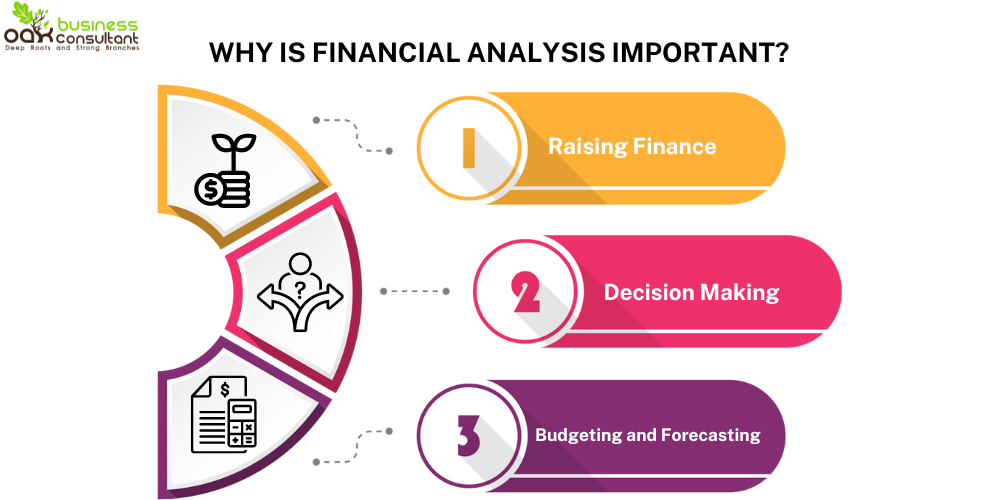
Raising Finance
Financial analysis is essential for determining the overall financial health of the company. Before investing or giving credit, investors, lenders, creditors, and a variety of other stakeholders must assess the company’s health. The choice of stakeholders to supply money will be based on a financial analysis of the financial statements.
Decision Making
All company choices, such as procuring materials and pricing, will be based on financial analysis. Companies must understand what they must charge in order to break even or attain a specific margin.
Budgeting and Forecasting
Budgeting is essential for ensuring that departments spend their time appropriately and appropriately. Cash allocation without a correct budget might result in liquidity issues. Budgeting gives you control over your resources and ensures that you reach your financial objectives. When creating a budget for future spending, you should use prior performance to create a plan that works for you.
As you have learned from the preceding essay, financial analysis is a vital tool for small business owners. There are several convincing explanations why you require it. First, we’ll position you better to make sensible business decisions if you have thorough financial information.
Benefits of Accurate Financial Statement Analysis
Financial statement analysis is critical for addressing the demands of stakeholders and other parties while also complying with corporate rules and regulations. However, acquiring skills and intuition is just as necessary as adhering to proper accounting processes in order to undertake accurate financial statement analysis.
Organizations can benefit from financial statement analysis in a variety of ways. For example, it gives internal and external stakeholders the ability to make educated investment decisions. Financial statement analysis also offers lending institutions an unbiased assessment of a company’s financial health, which aids in lending choices. And, because senior executives and others in management rely on accounting to offer an accurate portrayal of the consequences of their choices, financial statement analysis aids in corporate governance concerns as well.
Follow these guidelines for completing proper financial statement analysis:
- Maintain objectivity by understanding that judgments must be made on more than just the numbers on financial accounts. Accountants must also evaluate intangible elements. For example, considering employees’ happiness when budgeting for future financial expenses.
- A false sense of security should be avoided. While financial statements may be used to determine if a corporation is steady and successful, accountants should also observe business activity in real-time. A diminishing inventory, for example, that cannot be quickly refilled may pose significant problems.
- Maintain your focus on relevancy. Take account of recent patterns when assessing financial data. For example, while a trend favoring a company’s product may result in increased sales, it only sometimes gives an accurate comparison with the company’s competition.
- Trust your intuition because investing in a product should be based on more than just data. For example, considering past success in forecasting trends when making future investments.
The precise and timely examination of financial accounts is critical to business progress. While the fast speed of business nowadays emphasizes accountants’ insights, building expertise is still essential to establish a corporation. Incredibly beneficial venture for workers interested in a job that can significantly influence firms, investors, and consumers, who might be pursuing a master’s degree in accounting.
How Can Our Financial Analysis Service Help You?
At Oak Business Consultant, we’ll assess your company’s sales, profitability, stability, solvency, and liquidity using ratios rather than monetary quantities. These ratios will allow you to investigate correlations and get useful information for decision-making. In addition, the ratios we generate give a plethora of data that cannot be accessed elsewhere. As a result, they will serve as tools to enhance your decision-making, making you a better company manager overall.We will compare the financial performance of annual periods for you. We will need your trial balance for each fiscal year to complete this. Once we have this, our specialists will be able to discover numerical patterns that take time to be evident. In addition, a financial analysis, when performed regularly, may assist your small business in recognizing trends and adapting to those affecting your operations. Finally, our financial analysis service will give you an objective estimate of your company’s success.