






Website Hosting Financial Model


Original price was: $300.$95Current price is: $95.
This Excel template provides a comprehensive financial planning tool for website hosting businesses. Forecast revenue, costs, marketing ROI, and cash flows with dynamic, sector-specific modules. Includes automated financial statements, valuation analysis, and customizable inputs. Ideal for startups, investors, and analysts seeking data-driven insights for growth and funding. Fully adaptable to your business needs.
Frequently Bought Together
- Description
- Reviews (2)
Description
Dynamic Financial Model for Website Hosting Businesses
This Excel-based financial model template is designed specifically for website hosting startups or companies, providing a thorough end-to-end financial planning platform. The model enables you to forecast, analyze, and evaluate every critical aspect of operating a website hosting service.
Key Modules & Structure
1. Input Sheet
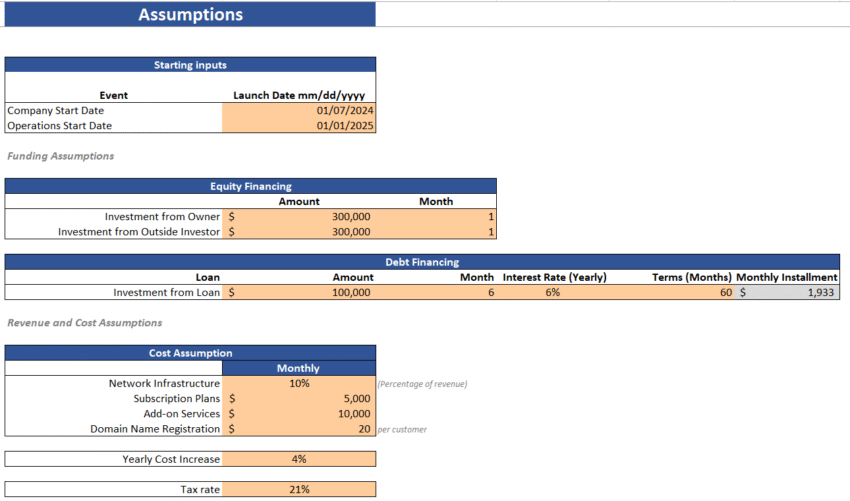
All core operational assumptions are configured here to power the rest of the model.
Covers:
- Company & operations start dates
- Equity and debt funding (amounts, terms, timing, interest rates)
- Revenue streams: segmentation, pricing, growth rates
- Cost categories: infrastructure, subscription, add-ons, and others
- Tax rate, cost inflation, and customer churn/repeat rates
- Marketing budgets, channel breakdowns, digital campaign costs (Google Ads, Facebook, Instagram, YouTube)
- Employee payroll planning and departmental costs
- Capital expenditure (CAPEX) for office/furnishing, networking, datacenter, computers
- Working capital details (receivable/payable days)
2. Revenue Analysis
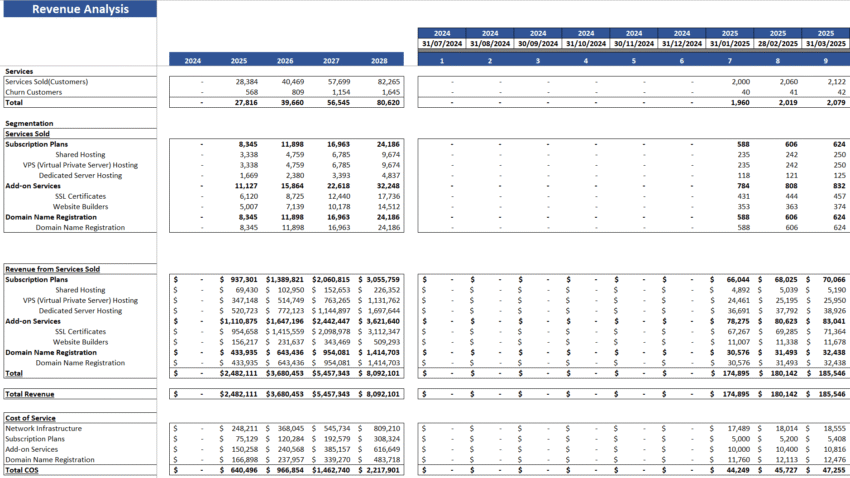
Dynamic, segmented revenue projections by service:
- Shared Hosting, VPS, Dedicated Servers
- Add-ons, SSL certificates, Website builders, Domain registrations
Includes:
- Monthly and annual growth, price escalations, and service-level breakdowns
- Churn and repeat business effects
- Customer number forecasts and conversion funnel from digital marketing spending
All calculations drive the five-year projection for user acquisition, sales volume, and revenue streams.
3. Marketing Budget
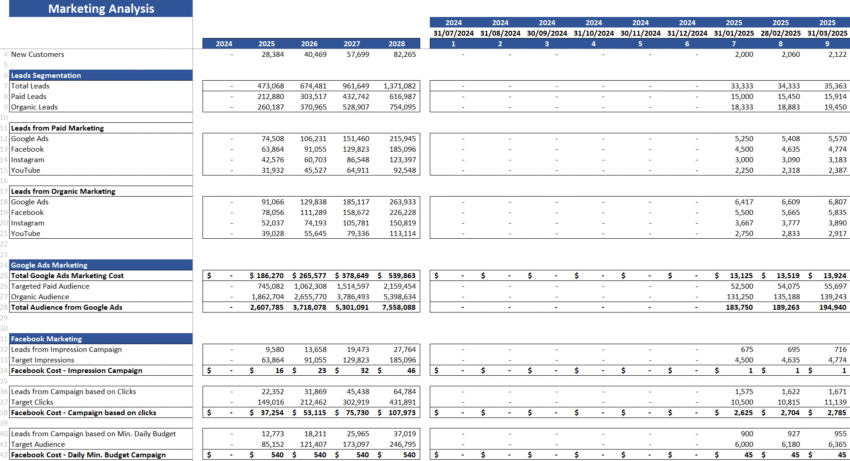
Integrated marketing strategy simulator:
- Allocate spend and simulate paid/organic leads across multiple digital channels.
- Track cost-per-lead, impressions, digital campaign performance, and resulting customer conversions.
- Drill into marketing ROI and cost-effectiveness by channel.
Visualizes total marketing spend, split by Google, Facebook, Instagram, YouTube, and their impact across the forecast horizon.
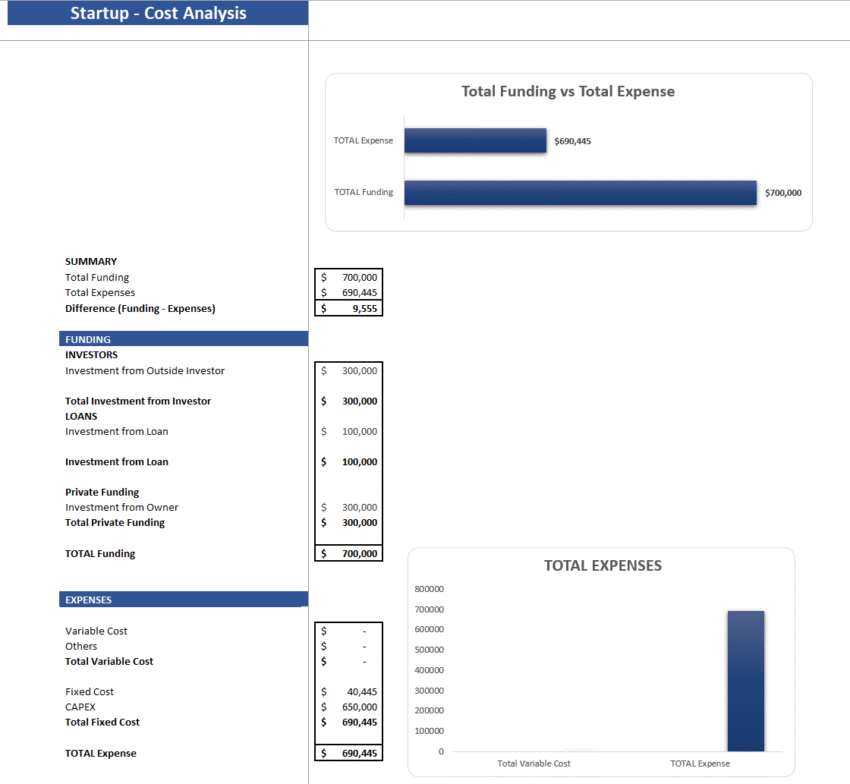
4. Startup Summary
Compilation of funding and initial cost breakdowns:
- Funding sources (owner, outside investors, loans)
- Usage of funds for both start-up expenses and assets
- CAPEX vs. OPEX split
- Opening balance sheet snapshot and initial cash flow outlook
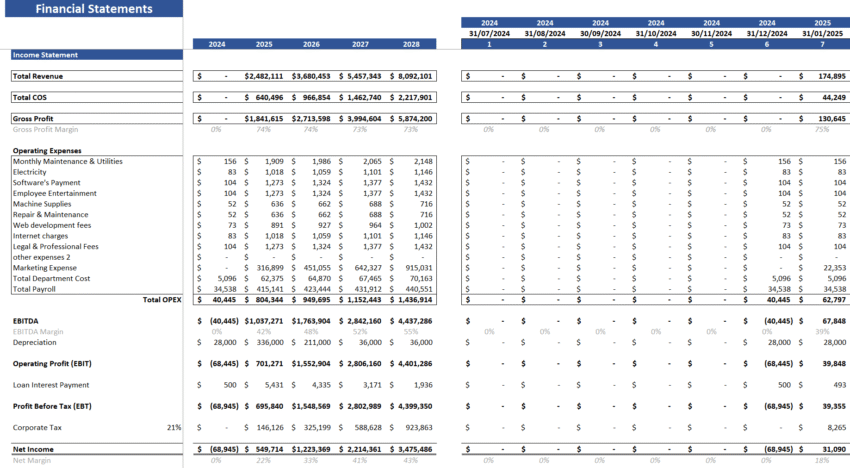
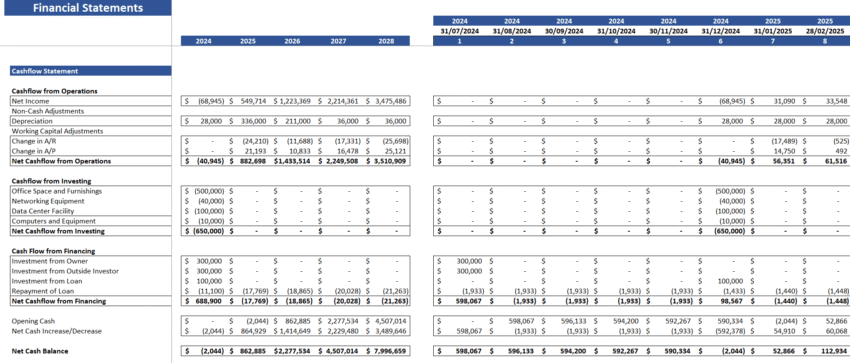
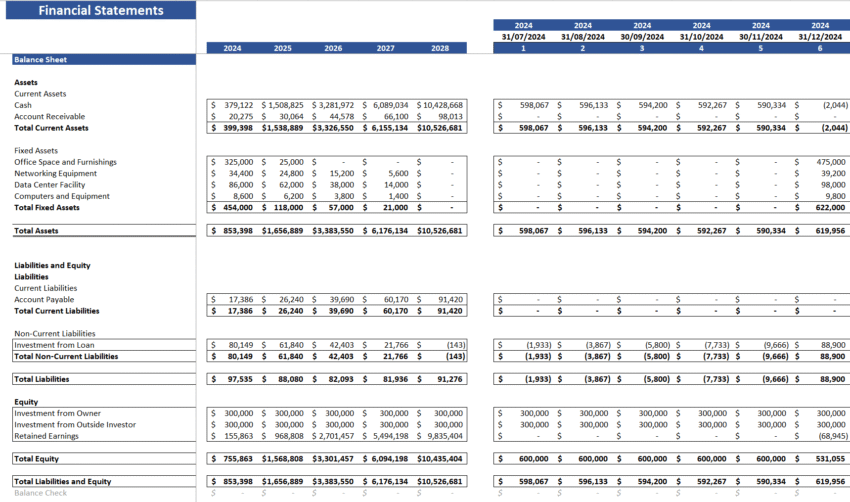
5. Financial Statements
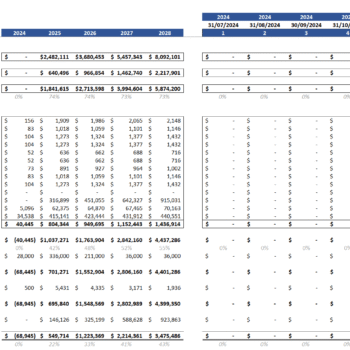
Fully automated financial projections for five years:
- Income Statement with revenue, COGS, gross profit, expenses, net income, and margins
- Balance Sheet by month and year, including cash, receivables, liabilities, and equity
- Cash Flow Statement with all operational, investment, and financing cash flows
All statements are built to update dynamically based on input assumptions.
6. Financial Analysis
Advanced analytics for business evaluation:
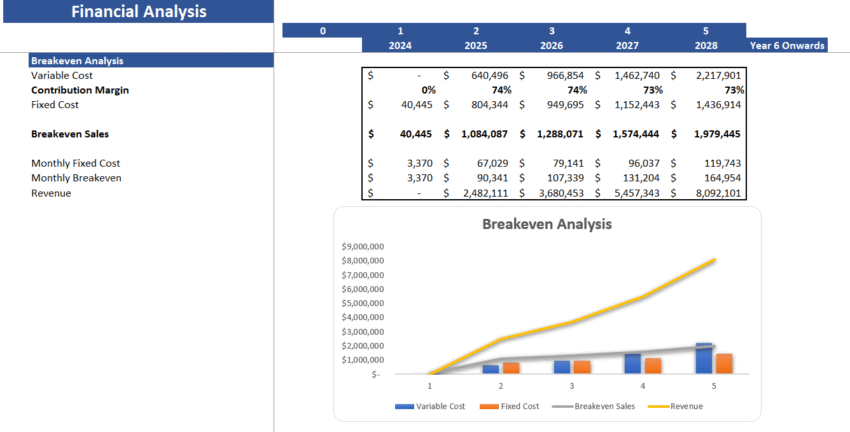
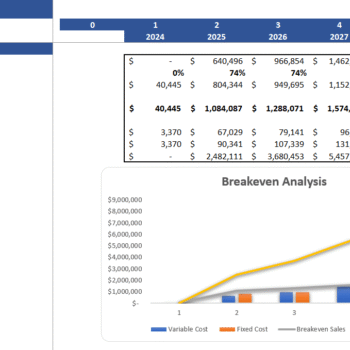
- Breakeven analysis by year and month
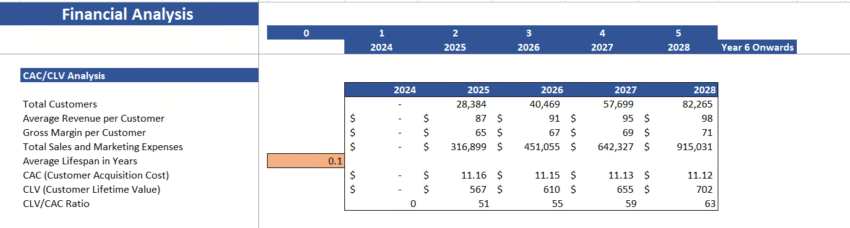
- Key SaaS/hosting SaaS metrics: CAC (Customer Acquisition Cost), CLV (Customer Lifetime Value), CLV/CAC ratio
Company valuation calculations:
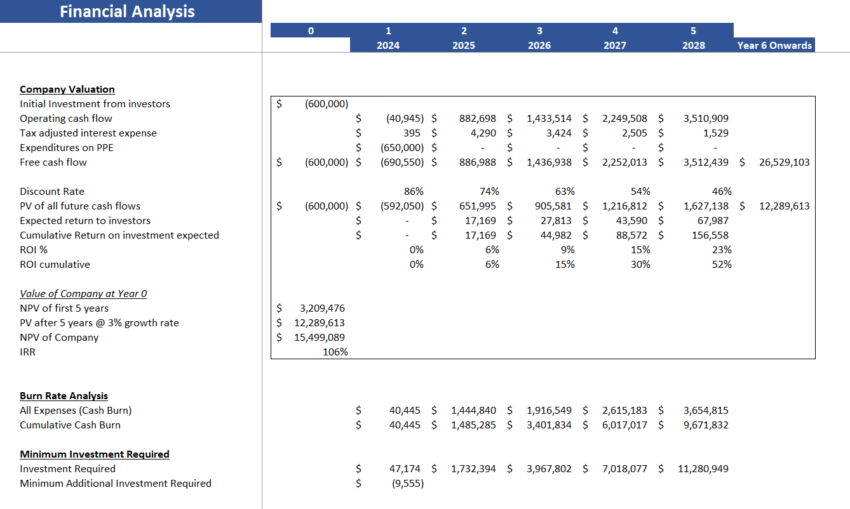
- Discounted Cash Flow (DCF), WACC, IRR, NPV, enterprise value scenarios
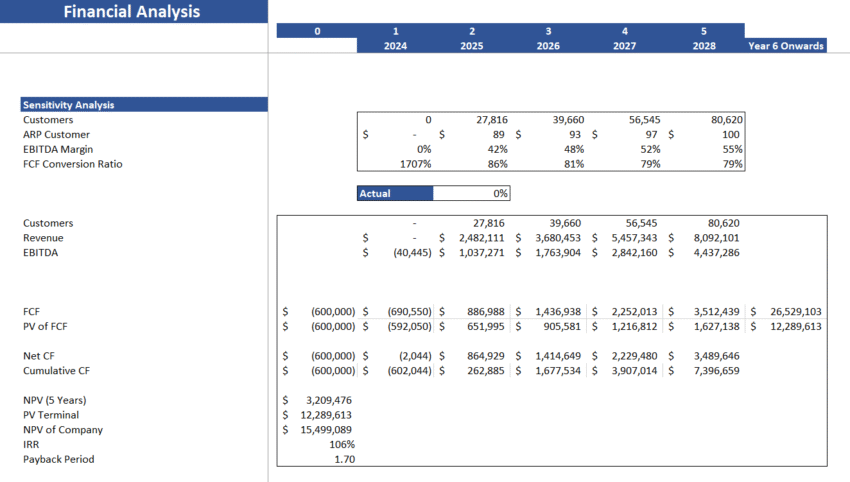
- Sensitivity analysis on customer volume and pricing
- Burn rate tracking, minimum investment needed, and payback analysis
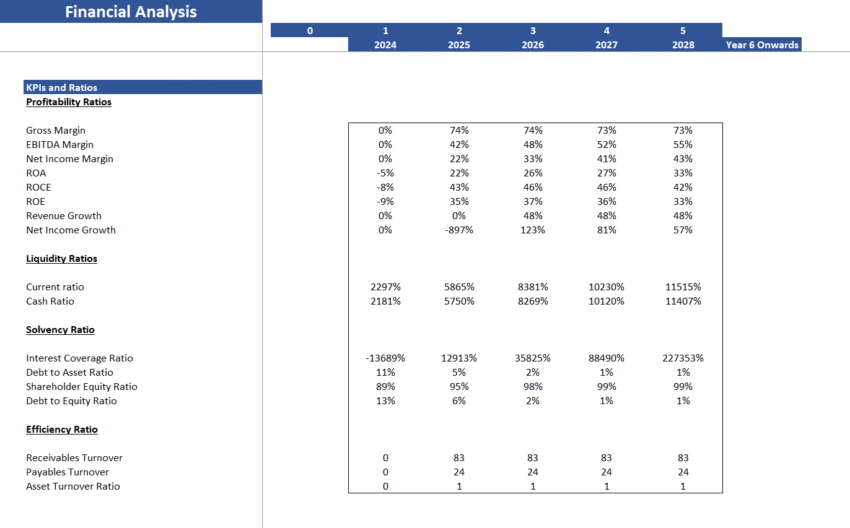
- Liquidity, profitability, and efficiency ratios (current ratio, net margin, ROA, ROE, etc.)
7. Working Sheet
Detailed payroll and operations calculator:
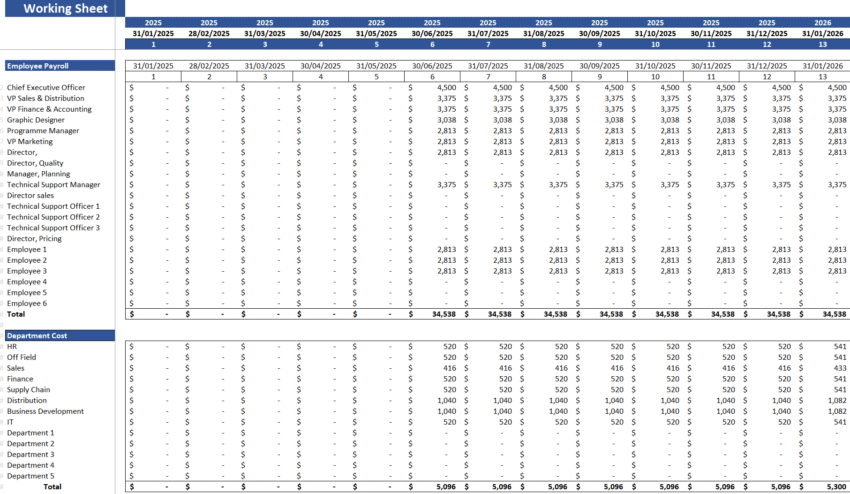
- Monthly breakdown of all employee compensation by role, level, and department
- Bonus, benefits, and payroll inflation forecasting
8. Dashboard
Executive summary visualization:
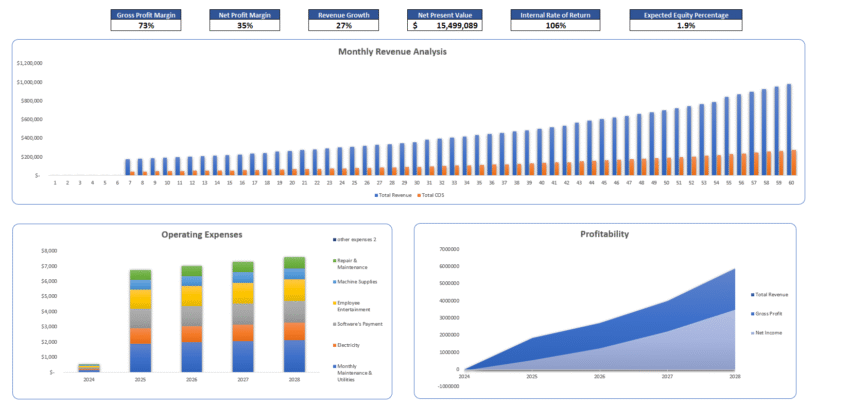
- Quick-access charts for revenue, profit, cash flow, customer growth, and KPIs
- High-level snapshots for investor or board presentations
What Makes This Model Unique
- Comprehensive SaaS/hosting logic: From digital marketing to billing, churn management, upsells, and monthly recurring revenue.
- Sector-specific depth: Pricing schemes, service add-ons, and virtual product segmentation tailored for hosting businesses.
- Scenario flexibility: Sensitivity toggles for aggressive vs. conservative growth, as well as digital marketing mix and pricing assumptions.
- Automated links: Each module updates throughout the entire financial model when changes are made in the Input Sheet, safeguarding consistency and reducing modeling error.
Who Should Use This Model?
- Founders building hosting startups or digital infrastructure companies
- Financial analysts preparing investor materials or due diligence
- Investors seeking to validate market, cash flow, and exit assumptions for website hosting businesses
Frequently Asked Questions (FAQs)
Q1: Who is this financial model for?
Website hosting startups, investors, financial analysts, and consultants seeking a robust tool for forecasting, strategic planning, and investment analysis.
Q2: Can I add or remove revenue streams or services?
Yes, all key revenue drivers and cost categories are modular—just adjust the Input Sheet accordingly.
Q3: How are digital marketing expenses calculated?
The Marketing Budget tab simulates multi-channel campaigns by platform (Google, Facebook, Instagram, YouTube). Adjust campaign costs, conversion rates, and paid/organic mix for custom lead generation and customer growth forecasts.
Q4: Is sensitivity analysis included?
Yes; change core assumptions (e.g., discount rates, growth, churn) and review how NPV, company value, and key ratios shift in real time.
Q5: Are financial statements automatically updated?
Yes. All projections, KPIs, and valuation figures update dynamically with changes to the input assumptions.
Q6: Is it possible to model debt financing and repayments?
Absolutely—the model supports loans, interest rates, terms, and calculates repayments in line with your schedule.
Q7: What if my business has unique costs or requires different assumptions?
The template can be fully customized—see below on customization options.
How to Utilize This Model
- Download & Open: Use Excel 2016+ for full compatibility.
- Navigate: Use tabs or the Table of Contents to switch sheets.
- Input Data: Edit only peach-colored cells (marked for user input).
- Auto-Calculation: Sheets update instantly when inputs change.
- Drop-Downs: Use menus for categories/scenarios
- Dashboards: Check summary sheets for real-time visuals.
- Scenarios: Adjust drivers (growth, budgets) for different cases.
- Export/Print: Save charts/tables as PDF or print directly.
Contact us for custom-tailored model development.
We offer expert services to adapt this Excel model to your exact requirements, ensuring accuracy, usability, and clarity for your fundraising or operational planning.
Walk Through Video
Watch our complete video walk-through below for a step-by-step demonstration of the Website Hosting Financial Model’s structure, navigation, and practical scenarios.
Terms of use
Oak Business Consultant and our range of products, including this financial model template, are not endorsed by or officially connected to any specific software or platform unless explicitly stated. Your purchase allows you a SINGLE LICENSE FOR PERSONAL OR BUSINESS USE, exclusive to your individual or company needs. Redistribution, resale, or sharing of the files and templates is strictly prohibited.
Note
Our product is a digital Excel file. Due to the nature of digital products, we cannot offer returns or exchanges. We encourage you to address any queries or seek clarification before finalizing your purchase.














Levi Martinez –
I must say it has been an invaluable tool for my business. The 5-year financial projection plan is a game-changer. I highly recommend the Website Hosting Financial Model to any business owner or entrepreneur who wants to gain better control over their company’s finances.
jamesbrown –
I appreciate how this Financial model helps mitigate financial risks by following up on the potential outcomes of different scenarios. It has enabled me to understand the impact of marketing campaigns, the cost of entering a new market, and how price variations can affect our business.