Case Study: Financial Modeling for Investments
Client Overview
A venture capital firm required expert support in evaluating multiple startups through detailed financial modeling for investments. Services included building three-statement models, performing DCF analysis, and calculating NPV, IRR, and cash flow projections. Comprehensive due diligence, market research, and comparable company analysis were also conducted to support informed investment decisions and optimize portfolio performance.
Challenges Faced by the Client in Evaluating Startup Investments
Overwhelming Deal Volume with Limited Internal Capacity
The venture capital firm received a high number of startup funding proposals. With a lean internal team, they were unable to conduct detailed financial analysis for each opportunity. The absence of a standardized process for financial modeling for investments created inconsistencies in evaluating early-stage ventures across the pipeline.
Lack of Structured Financial Modeling and Forecasting
Each funding proposal required robust three-statement models—covering income statement, balance sheet, and cash flow statement. However, the client lacked the tools and expertise for accurate financial forecasting, scenario planning, and sensitivity analysis. They also could not consistently apply DCF analysis, calculate net present value (NPV), or determine internal rate of return (IRR), which are essential for evaluating long-term value creation.
Gaps in Market Research and Business Model Validation
Many startups presented incomplete market analysis and weak financial assumptions. The firm was unable to validate market size using TAM, SAM, and SOM models. Competitive positioning, pricing strategy, and go-to-market plans were either missing or not backed by data. This made it difficult to assess scalability and future financial performance.
Inconsistent Due Diligence Framework
There was no formal due diligence process in place to assess operational and strategic readiness. Key areas—such as team capability, product development roadmap, technology infrastructure, and business model design—were not consistently reviewed. As a result, the firm faced high risk exposure and lacked confidence in early-stage investments.
No Clear Benchmarking or Portfolio Comparison
Without a structured method for comparable company analysis or valuation benchmarking, the firm could not rank investment opportunities objectively. Financial metrics like IRR, NPV, payback period, and profitability were not used to compare startups. This limited their ability to prioritize deals with the highest return potential.
Investor Materials Lacked Financial and Strategic Depth
Most startups approached the firm without a professional pitch deck or investor-ready documentation. The presentations lacked key financial metrics, strategic positioning, and long-term revenue models. This delayed decision-making, made internal reviews inefficient, and reduced overall confidence in funding readiness.
Comprehensive Financial Advisory and Investment Support for Venture Capital Firm
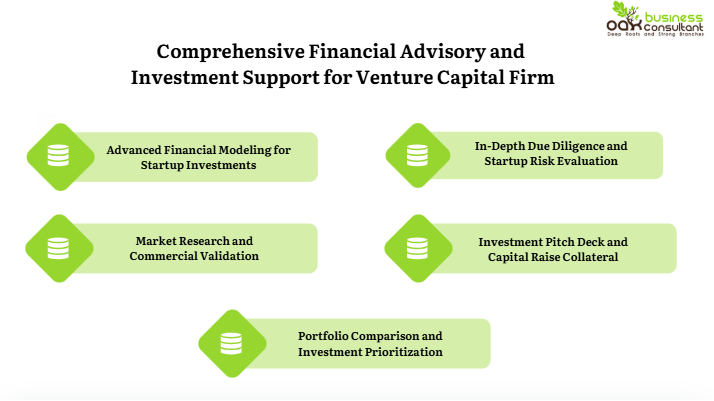
We delivered a full-spectrum financial consulting engagement for a venture capital and private investment firm evaluating early-stage startup opportunities. Our objective was to provide strategic investment support through robust financial modeling, startup valuation, market research, due diligence, and investor material preparation. This end-to-end solution enabled the client to assess investment readiness, minimize financial risk, and enhance return on investment (ROI) across a dynamic portfolio of ventures. The service offering was tailored to the needs of angel investors, venture capital partners, family offices, and private equity stakeholders seeking structured startup evaluation and investment insights.
Advanced Financial Modeling for Startup Investments
Our financial analysts developed dynamic, fully-integrated three-statement financial models for both holding structures and individual startup entities. These models incorporated projected income statements, cash flow statements, and balance sheets—aligned with startup growth cycles and sector-specific metrics. We included discounted cash flow (DCF) valuation models with scenario planning to calculate Net Present Value (NPV), Internal Rate of Return (IRR), profitability index, and payback periods.
Models were stress-tested using sensitivity analysis, Monte Carlo simulations, and multi-scenario projections to evaluate financial risk, revenue volatility, and break-even timelines. Revenue models captured subscription pricing, transactional income, and recurring revenue streams, while operating expenses and EBITDA margin forecasts reflected burn rate analysis and capital runway estimation. The models supported investor communication, capital budgeting, valuation negotiation, and investment approval workflows.
In-Depth Due Diligence and Startup Risk Evaluation
We conducted comprehensive due diligence to support investment decisions and mitigate exposure. Our process included financial due diligence, commercial due diligence, legal and regulatory compliance review, and operational assessments. Key evaluation areas included:
- Founding team experience, domain expertise, and operational track record
- Product development maturity and technical infrastructure scalability
- Product-market fit, pricing models, and customer acquisition strategy
- GTM (go-to-market) planning, sales funnel architecture, and distribution risk
- Legal entity structure, IP ownership, regulatory filings, and tax positioning
- Competitor analysis and benchmarking with comparable startups using EV/EBITDA, revenue multiples, and P/E ratios
We used structured due diligence scorecards to assess execution risk, technical dependencies, customer churn risk, and revenue concentration. This enabled a systematic risk assessment for each target startup.
Market Research and Commercial Validation
Our team performed strategic market research to validate investment theses, quantify market potential, and assess competitive dynamics. We analyzed TAM (Total Addressable Market), SAM (Serviceable Available Market), and SOM (Serviceable Obtainable Market) for each product segment. Research focused on customer demographics, pricing sensitivity, market trends, and regulatory constraints.
We conducted SWOT analysis, competitive positioning matrices, and customer segmentation strategies to identify commercial viability. Forecasting models used bottom-up projections based on customer lifetime value (LTV), churn rates, and cost of customer acquisition (CAC). Research findings helped support market-entry strategies, unit economics validation, and investor readiness.
Investment Pitch Deck and Capital Raise Collateral
We developed high-impact, investor-grade pitch decks to support fundraising efforts. These decks were tailored for venture capital firms, angel networks, accelerator programs, and institutional investors. Content included:
- Company overview, founding story, and strategic vision
- Product features, traction metrics, and customer testimonials
- Financial projections, valuation rationale, and use of funds
- Revenue model, cost drivers, and gross margin targets
- Exit strategy, investor ROI, and equity dilution projections
All pitch materials followed investment banking standards with visual storytelling, data-driven slides, and performance KPIs. The decks facilitated successful investor engagement, due diligence reviews, and pitch day presentations.
Portfolio Comparison and Investment Prioritization
We implemented a structured framework for evaluating multiple early-stage ventures. Using standardized metrics like DCF valuation, IRR comparison, capital efficiency, and NPV ranking, we provided an objective basis for funding prioritization. Key decision criteria included:
- Expected return on capital (ROIC)
- Scalability and market penetration potential
- Operating leverage and customer acquisition metrics
- Alignment with long-term VC investment thesis
- Equity structure, funding stages, and term sheet positioning
This portfolio analysis supported capital allocation decisions, portfolio diversification strategy, and post-investment performance monitoring. Our advisory extended to scenario modeling, fundraising strategy, shareholder dilution mapping, and deal structuring.
Outcome
Our tailored approach to financial modeling for investments empowered the venture capital firm to evaluate startups with greater precision and confidence. Through standardized three-statement models, DCF analysis, and ROI-focused metrics such as NPV and IRR, the firm was able to benchmark opportunities consistently. Our structured due diligence, market validation, and investment prioritization frameworks reduced risk, accelerated deal flow, and optimized capital deployment. The result was a scalable, data-driven investment process that improved portfolio performance and supported long-term strategic growth.
What’s in It for You?
If you’re a venture capital investor, startup founder, or private equity professional navigating high volumes of early-stage deals, the lack of structured financial analysis exposes you to significant risks:
- Inaccurate financial projections may lead to poor valuation decisions, missed opportunities, and misaligned investment strategies.
- Uncontrolled operating costs and an unclear burn rate hinder your ability to forecast capital runway and assess cash requirements.
- Fragmented capital allocation decisions reduce efficiency across product development, go-to-market (GTM), and hiring initiatives.
- Volatile cash flow forecasts make it difficult to model breakeven timelines or assess financial sustainability under different scenarios.
- Investor confidence weakens without reliable models for NPV, IRR, and revenue forecasting, delaying capital deployment or follow-on funding.
How Can You Overcome These Challenges?
By deploying a custom-built, Excel-based financial model for startup investments, tailored to your sector and funding stage, you gain strategic control:
- Gain complete financial clarity with integrated three-statement models, cap table tracking, and valuation sensitivity tools.
- Run detailed DCF and IRR analyses, scenario modeling, and capital budgeting for consistent startup comparison and deal prioritization.
- Standardize due diligence across investments with scorecards evaluating team, market size, and product maturity.
- Forecast revenue and cost drivers with high granularity—LTV, CAC, pricing models, and recurring vs. one-time income.
- Develop investor-grade reporting using dynamic dashboards, KPI benchmarking, and fund utilization metrics that align with VC expectations.
This approach ensures that every funding decision is data-backed, scalable, and aligned with your long-term portfolio strategy.
Frequently Asked Questions
Why is financial modeling important for venture capital investments?
Financial modeling for investments helps forecast cash flows, calculate NPV, IRR, and assess startup valuation. It supports informed decision-making by evaluating financial performance, growth potential, and profitability through tools like DCF, scenario analysis, and three-statement models.
What does a due diligence report include?
Due diligence covers team analysis, product architecture, revenue model, market research, competitive positioning, risk factors, and legal structure. It validates the financial model and ensures alignment with investment criteria, exit strategy, and scalability.
How does market research support early-stage investments?
Market research helps define TAM, SAM, SOM, pricing models, and customer acquisition strategy. It supports valuation models and strengthens assumptions in financial forecasting and scenario planning.
What is included in the pitch deck development process?
A pitch deck includes business model, revenue forecast, cost structure, WACC, funding roadmap, valuation, CAC, LTV, and market size. It’s built using insights from financial models and comparable company analysis to attract venture capital funding.
How are companies compared for investment selection?
Startups are assessed using discounted cash flow, IRR, NPV comparison, income statement, balance sheet, breakeven analysis, and profitability metrics. This comparison helps identify high-performing ventures for capital allocation.
Conclusion
We supported the venture capital firm with expert financial modeling, startup valuation, due diligence, and market research, enabling smarter investment decisions and improved portfolio performance. Our structured approach using DCF, NPV, IRR, and comparable analysis helped prioritize high-potential startups and reduce investment risk. Ready to enhance your investment process? Contact us for tailored VC advisory, financial analysis, and startup financial model services.