How to Build a Powerful Financial Model
How to Build a Powerful Financial Model | Financial Forecasting & Valuation
A well-constructed Financial Model is the core analytical tool for every major strategic decision. How to Build a Powerful Financial Model is essential knowledge for securing startup funding and navigating Mergers and acquisitions.The dynamic tool forecasts a company’s future financial performance and aids in business valuation. The fundamental purpose of Financial Modeling is to transform assumptions and historical financial inputs into actionable financial projections and insights. Whether you are aiming to raise venture capital or optimize internal financial planning, mastering the model-building process is essential for effective risk management and achieving long-term projections.
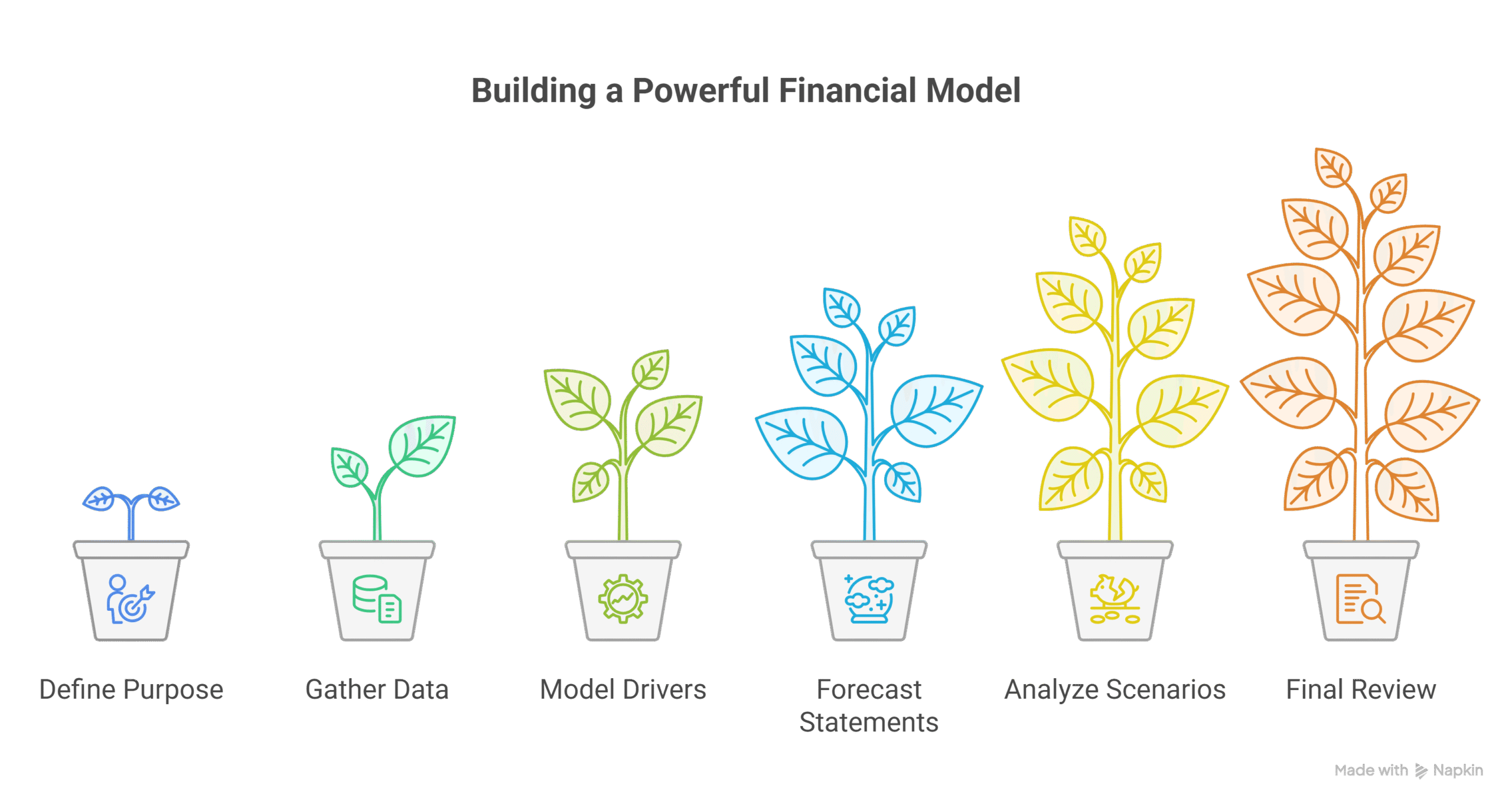
1. Define the Model’s Purpose and Scope
Before entering any spreadsheet formulas, you must define the goals the Financial Model is intended to achieve. Different models serve different purposes:
- Valuation: A discounted cash flow (DCF) model or an LBO model (for private equity firms) focuses on calculating the inherent market value of the business.
- Startup/SaaS: A Startup Financial Model focuses heavily on revenue growth, customer acquisition, Churn Rate, and Customer Acquisition Cost (CAC).
- M&A/Investment Banking: Models focus on synergy analysis and integrating the financial statements of two companies.
The scope dictates the necessary level of detail and the primary Key Performance Indicators (KPIs) you need to track.
2. Gather and Structure Historical Financial Data (The 3-Statement Core)
The foundation of any credible financial forecast is the 3-statement model: the Income Statement, Balance Sheet, and Cash Flow statements.
- Input the Historical Data: Collect at least three years of audited financial statements. This history anchors your financial projections in reality.
- Integrate the Statements: Ensure the three financial statements are perfectly linked. For example, net income from the Income Statement flows into Retained Earnings on the Balance Sheet. The change in Balance Sheet items (like Accounts Receivable) then determines the adjustments needed to derive cash flows in the Cash Flow statements.
3. Identify and Model the Core Drivers
This is where the real value of Financial Modeling is created. Instead of simply extending historical numbers, you must identify the operating drivers and value drivers of the business.
- Revenue Forecasting: This is crucial. For SaaS companies, this involves modeling users, pricing, Churn Rate, and growth numbers based on Market research and Ad/marketing/sales drivers. For traditional businesses, it relies on sales volume and average pricing, informed by assumptions about market share and market data.
- Cost Drivers: Model the Cost of Goods Sold (COGS) as a percentage of revenue or per unit. Model SG&A (Selling, General and Administrative) expenses based on headcount and necessary fixed costs. Interest expense is calculated based on debt levels from the Balance Sheet.
- Working Capital & CapEx: Model changes in working capital (Accounts Receivable, Accounts Payable) and capital expenditures (CapEx) based on revenue growth and the need for new assets.
4. Calculate and Forecast the Financial Statements
Once the drivers are built, you can complete the long-term projections for your financial statements (typically 5 to 10 years).
- Project the Income Statement: Start with revenue forecasting, subtract Cost of Goods Sold, calculate Gross Profit, deduct operating expenses (including SG&A), and finally subtract interest expense to arrive at Net Income.
- Project the Balance Sheet: Use the Net Income and cash flows from the other two statements to balance Assets with Liabilities and Equity.
- Project the Cash Flow statements: This statement links the other two and shows the movement of cash flows from operating, investing, and financing activities. The projected ending cash flows should tie back to the cash balance on the Balance Sheet. This integration is paramount to building a sound Financial Model.
5. Perform Scenario Analysis and Risk Management
A good Financial Model doesn’t just present a single number. It helps you navigate market conditions and manage potential financial risks.
- Scenario Planning: Create distinct financial forecast scenarios (e.g., Best Case, Base Case, Worst Case). Do this by changing the key financial inputs like revenue growth or customer churn rates. This provides a range of potential financial projections.
- Sensitivity analysis: Test how sensitive the financial outputs (like the discounted cash flow valuation or net income) are to changes in a single variable. This could be the discount rate or Cost of Goods Sold. This is crucial for risk management and understanding business performance.
6. Final Review and Presentation
Before presenting your model to venture capital investors, investment banking clients, or private equity partners, the final checks are critical.
- Audit Formulas: Check that all spreadsheet formulas are correct, especially the links between the Balance Sheet and Cash Flow statements. Use tools like the IFERROR Function to handle potential errors gracefully.
- Format and Clarity: Use consistent color coding to distinguish between inputs (hard-coded numbers) and outputs (formulas). A clean layout is essential for effective financial planning and external use.
Frequently Asked Questions
What is the core difference between a “financial forecast” and “financial projections”?
A financial forecast uses current and historical data to predict the future based on known trends. Financial projections are broader; they involve making assumptions about future market conditions and internal strategy (like a new product launch or acquisition) that may differ significantly from the past.
Why is the 3-statement model considered the foundation of financial modeling?
The 3-statement model (Income Statement, Balance Sheet, and Cash Flow statements) provides a complete picture of a company’s financial health. You must integrate them accurately because a change in one statement (e.g., higher revenue on the Income Statement) logically flows through and impacts the others (e.g., higher cash on the Balance Sheet and higher operating cash flows).
What role does “discounted cash flow” (DCF) play in financial modeling?
Investment bankers and private equity professionals use the discounted cash flow (DCF) method as a core valuation technique. It takes the long-term projections of a company’s free cash flows from the model and discounts them back to the present using a discount rate to determine the company’s intrinsic market value.
How do SaaS companies use the Churn Rate in their financial models?
For SaaS companies, the Churn Rate is a critical operating driver. It directly impacts future revenue growth. A higher Churn Rate means a company must spend more on customer acquisition (increasing the Customer Acquisition Cost or CAC) just to stay even, significantly degrading the profitability shown in the financial forecast.
Conclusion
The Financial Model is the essential mechanism that guides strategic action and capital decisions. Understanding how to build a powerful financial model helps ensure a robust, accurate 3-statement model, built upon detailed revenue forecasting and thorough scenario planning, which is critical for managing financial risks and achieving precise financial projections. Mastering the model-building process is the hallmark of effective financial planning.
Stop struggling with basic, error-prone spreadsheets. We will help you build a robust, sophisticated financial model as per your requirements, ensuring accuracy for your strategic scenario analysis and financial forecasting. Contact us today to explore our expert financial modeling services and take control of your company’s strategic future!