Financial Statement Analysis with Large Language Models
Large Language Models: A New Era for Financial Statement Analysis
The emergence of Financial Statement Analysis with Large Language Models is fundamentally changing how we do financial statement analysis. These advanced AIs, built on a specific AI design called the transformer architecture, are helping financial analysts process, understand, and predict insights from huge amounts of complex financial data. In the past, financial analysis took a long time, relying on people to manually calculate financial ratios from documents like the balance sheet and income statement. Today, LLMs automate these steps, making earnings prediction faster and more accurate. In some tests, Large Language Models even perform better than human financial analysts.
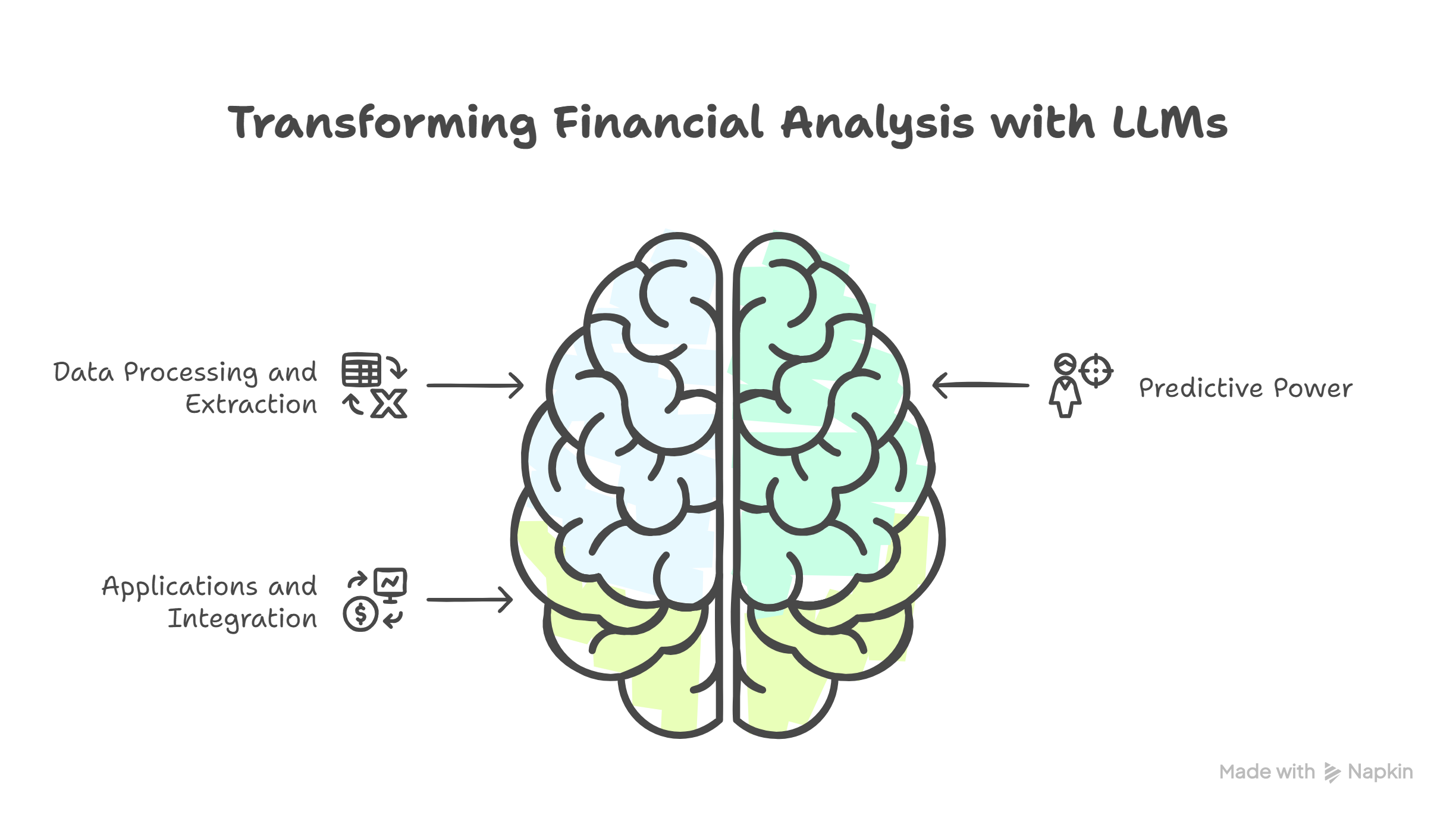
1. Transforming Data Processing and Extraction
The most immediate benefit of LLMs in financial analysis is their power to handle the volume and complexity of financial data.
- Handling Messy Documents: Financial statements are complex, combining numerical tables with long sections of text (like footnotes). Large Language Models can read and understand the specialized financial language in these filings. This allows LLMs to quickly extract key numbers from documents and assist with tasks like an SEC filing assistant might perform, standardizing the data for financial modeling.
- Narrative Summarization: An LLM can read a massive annual report and summarize the crucial qualitative insights and risks in minutes. This dramatically speeds up investment research.
2. Predictive Power: LLMs vs. Human Analysts
Research, including studies from the University of Chicago’s Booth School of Business, directly compares the performance of LLMs against human financial analysts. The success of financial statement analysis with large language models in predictive tasks is notable.
- Superior Earnings Prediction: These studies show that advanced Large Language Models can be highly effective. When given standardized financial statements (the balance sheet and income statement), the models often predict the direction of future earnings prediction better than the average human analyst.
- Emulating Reasoning: The reason for this success is the LLMs’ ability to use step-by-step reasoning. This guides the AI to mimic how a seasoned analyst systematically calculates financial ratios and synthesizes trends.
- Economic Value: Trading strategies based on LLMs often show better results than old methods (like logistic regression or simple artificial neural networks). They frequently produce higher Sharpe ratios, meaning they generate better returns for the amount of risk taken, making them better at predicting stock price movements.
3. Applications and Integration
Large Language Models are powerful augmentation tools that integrate into various parts of the financial statement analysis workflow.
| Application Area | LLM Function | Benefit to Financial Analysts |
| Ratio Analysis | Automatically calculating complex financial ratios (like profitability or liquidity) and assessing bankruptcy risk. | Reduces human error and automates labor-intensive, multi-step calculations. |
| Trading Strategies | Analyzing real-time financial data and news sentiment to optimize automated buying and selling rules. | Enables high-speed, data-driven decision-making for short-term market movements. |
| Investment Research | Summarizing research papers, quickly comparing the performance of similar companies, and generating initial reports. | Speeds up the research phase, allowing the human financial analysts to focus on deep context and judgment. |
The future of financial statement analysis with large language models will be a hybrid workflow. LLMs handle the scale, speed, and objectivity of data processing, freeing human financial analysts to provide the critical judgment and contextual knowledge.
Frequently Asked Questions
What is a Large Language Model (LLM) in finance?
An LLM is an advanced AI system trained on massive amounts of text and financial data to understand, generate, and process financial language. In finance, they are used to analyze financial statements and predict trends.
How are LLMs outperforming human financial analysts?
Studies from institutions like the University of Chicago show that LLMs are better at synthesizing large amounts of structured and unstructured financial data quickly and objectively. They excel in specific tasks, particularly the earnings prediction of a company’s stock direction.
What is a Sharpe Ratio, and why is it important for LLMs?
The Sharpe ratios measures the return of an investment compared to its risk. It is a key metric for evaluating trading strategies. When an LLM-based strategy has a higher Sharpe ratios, it means the AI is generating better profits for the level of risk it takes, confirming its value in investment research.
Are Large Language Models replacing financial analysts?
No. LLMs automate data extraction, calculation, and initial earnings prediction. They are currently best used as an augmentation tool, handling the scale of financial data while human financial analysts provide the necessary oversight, contextual judgment, and decision-making authority.
How do LLMs handle complex financial statements like the Balance Sheet?
LLMs process the balance sheet and income statement by reading the tables and the accompanying text (like footnotes). They can extract the relevant figures, calculate financial ratios, and integrate the data, which is crucial for accurate financial modeling.
Conclusion
Large Language Models have moved beyond theory to become a powerful, proven tool in financial analysis. Research confirms they are highly capable of performing predictive tasks like earnings prediction with high accuracy. The advancement of financial statement analysis with large language models marks a significant milestone. By automating the extraction of financial data from complex financial statements and improving the efficacy of trading strategies via metrics like Sharpe ratios, LLMs are set to become a foundational component of modern financial modeling and investment research.
Ready to elevate your investment decisions? Discover how state-of-the-art financial models can streamline your analysis and enhance your trading strategies. Contact us today to learn more about our customized financial modeling services tailored to your specific data and investment needs.